Lunara
Usually the matrix is computed on one site, the natal chart on another, and Tarot lives in an app. In Lunara it all lives in one workspace and starts from one birth date. The whole service starts with a single Docker command.
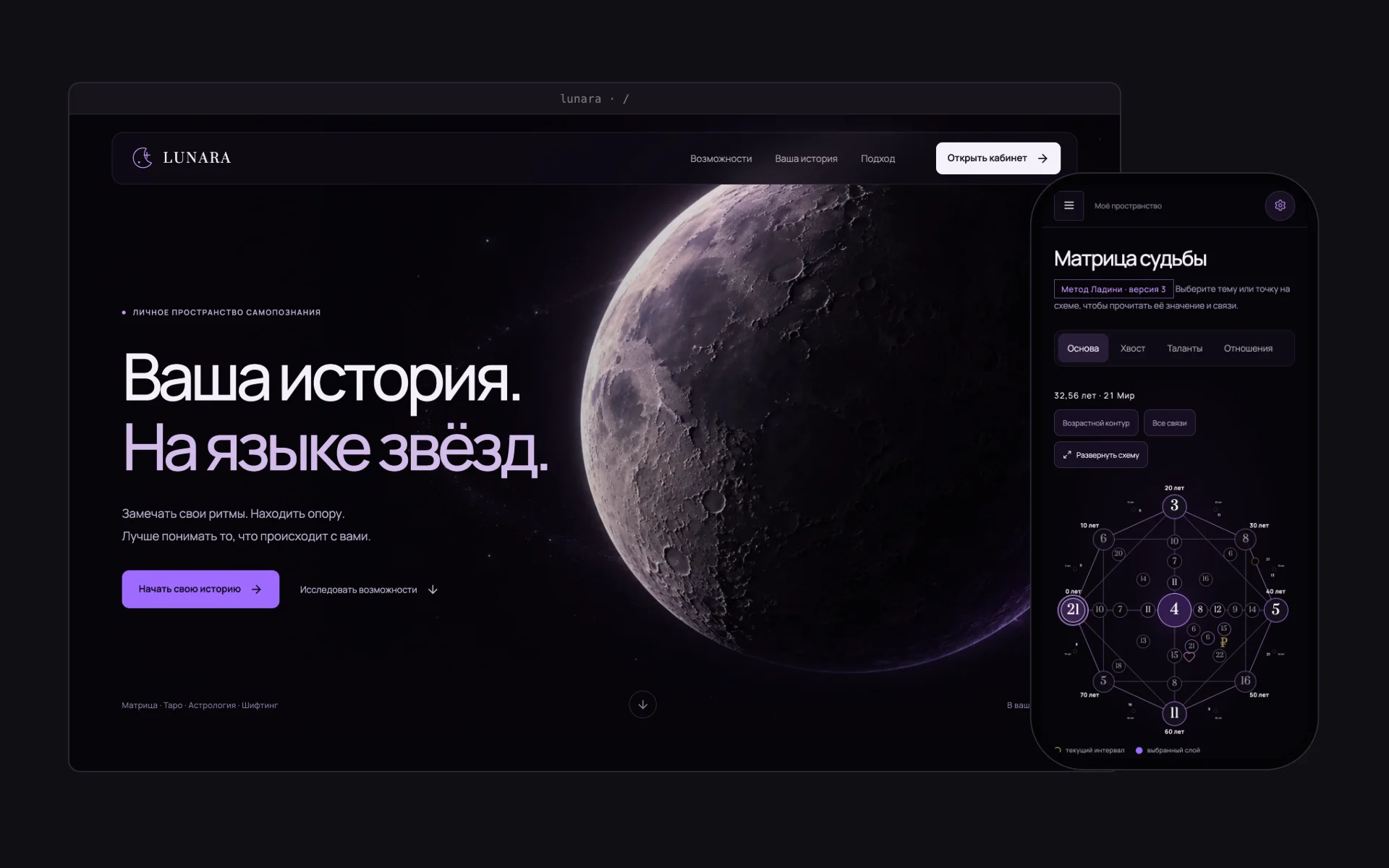
The idea
Lunara is not a daily horoscope but a workspace. You enter your birth date once, and from then on the matrix, the natal chart and Tarot speak about you in one language. There is no sign-up: the service creates a local workspace by itself, and all data can be wiped with one button.
Exact calculations
The destiny matrix follows the Ladini method, version 3: the reference octagram of 22 arcana, ancestral points, the relationship and money lines, chakras and an age contour. The natal chart is built on Swiss Ephemeris with Placidus houses, aspects, transits and synastry. Tarot has all 78 Rider–Waite–Smith cards and eight spreads.
Design
A dark lunar interface in a lilac palette. The home screen opens with the Moon and one line: “Your story. In the language of the stars.” The diagrams are interactive: tap any point on the matrix or the natal wheel to read its meaning and links. Tarot cards turn over one at a time, at your own pace.
AI that does not make things up
Readings and the dialogue go through one AI adapter: DeepSeek in production or an isolated local model for development. Memory is stored as vectors in PostgreSQL. If the model is unavailable, the service reports an honest error instead of showing placeholder text.
How Lunara works
A brass astrolabe: the date dial turns three tiers through a gear train — the 12 houses of the natal chart, the matrix octagram of 22 arcana and the deck of 78 Tarot cards. The index tabs on the right read what sits under them.
Screens
Under the hood
- Front end on React, TypeScript and Vite; back end on Java and Spring Boot; PostgreSQL 16 with pgvector.
- A separate Python service turns memory into vectors with the multilingual-e5-small model.
- The whole service starts with one docker compose command: database, back end, memory service and web interface.
- Reports are produced as a web page and as a real PDF.
- Playwright browser tests at 390, 768, 1024 and 1440 px with reference screenshots and accessibility checks.
React · TypeScript · Spring Boot · PostgreSQL · pgvector · Swiss Ephemeris · Docker