Priyomnaya
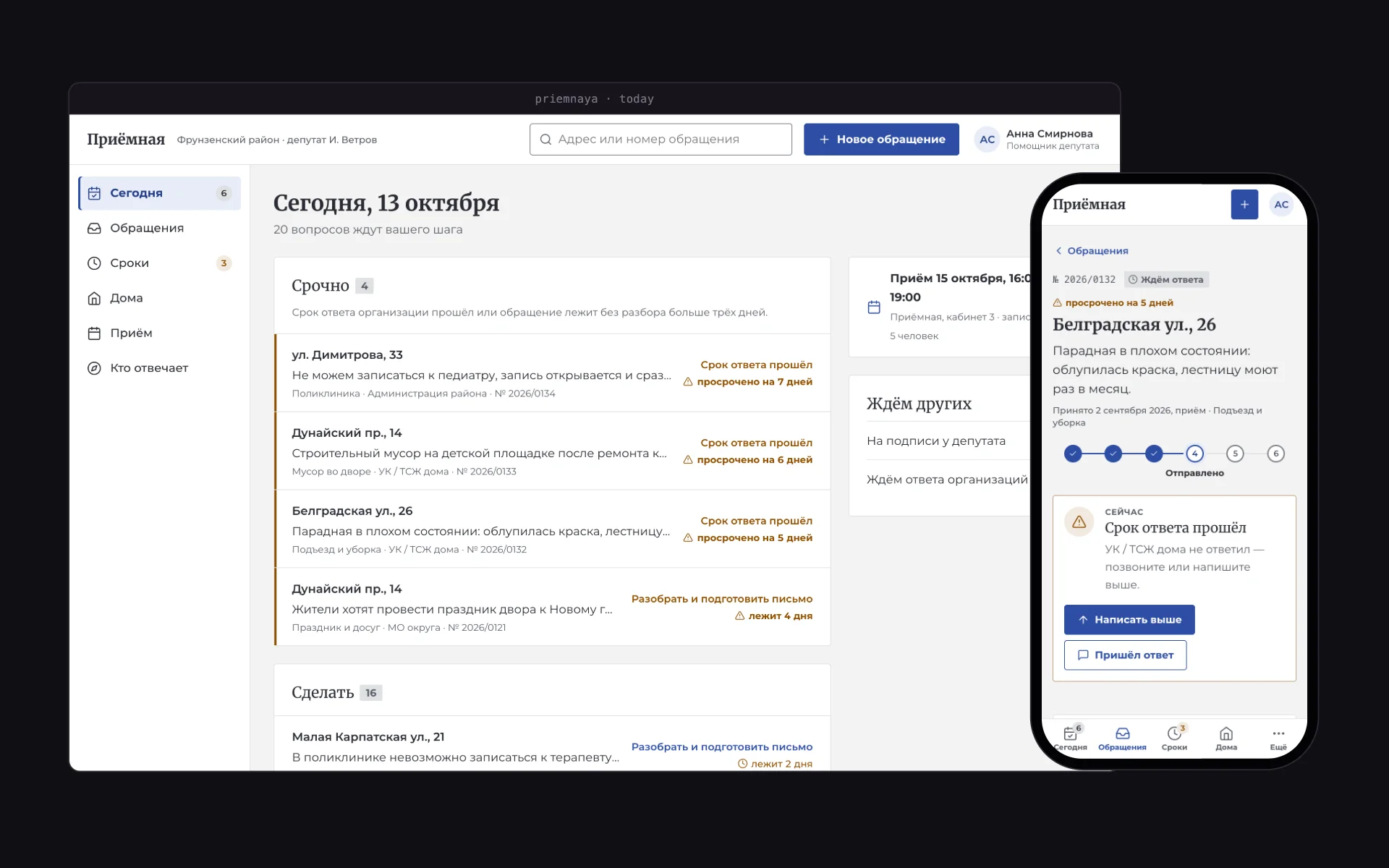
In a deputy’s office, requests arrive by letter, by phone and in person, and the reply deadlines live in the assistant’s head. Priyomnaya walks each request step by step until the resident hears the outcome.
The brief
The assistant needs to see what is urgent today, what is waiting for a signature and where an organisation is late with a reply. The deputy needs only the letters to sign. The resident needs a clear outcome.
Six steps
Every request has a six-step track: review, letter, signature, sent, reply, resident informed. The card always shows the next action. If there is already a request about the same building, the service offers to add the resident to it, so one collective letter goes out.
A letter from the review
The “Who answers” reference links a topic to the organisation and the legal norms, and every norm links to its text. The letter is drafted from the review with the norm citations; the deputy signs it and assigns an outgoing number.
Residents’ data
A Node server with no external dependencies keeps the data in the built-in SQLite, encrypts applicants’ details with AES-256-GCM and signs users in with one-time codes. Actions go into a log where every entry is chained to the previous one.
How a request reaches the resident
A request moves along a six-step track. Questions about one building are gathered into one envelope, the letter passes the norms reference and the signature, and a dial shows how many days are left until the reply deadline.
Screens
Under the hood
- Interface on React and TypeScript; a Node server with no external dependencies and built-in SQLite.
- Applicants’ data encrypted with AES-256-GCM, one-time-code sign-in and a chained action log.
- The “Who answers” reference: topic, organisation and legal norms with links to the text.
- A dark theme, a phone layout with a bottom bar and a printable notice for the building entrance.
- A pre-pilot prototype: every resident and address in the demo database is fictional.
React · TypeScript · Node.js · SQLite